Why carbon data will be won or lost on market design, not sustainability ambition

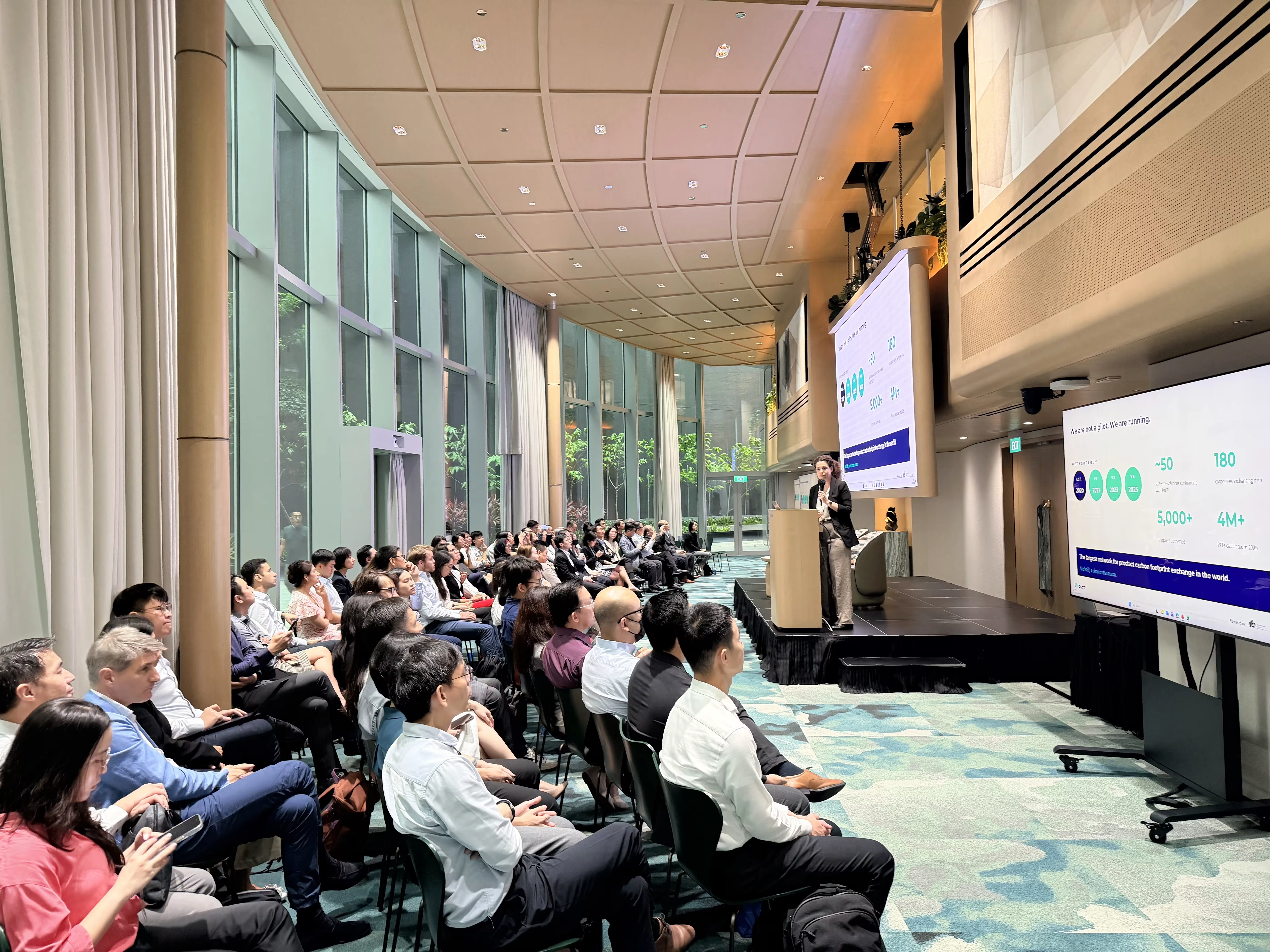
I spent four days in Singapore last week for Ecosperity Week, the largest sustainability conference in APAC. I co-led two sessions with the Singapore Business Federation (SBF), moderated a roundtable on sustainable supply chains, sat in on discussions about climate finance and natural capital accounting, and had more bilateral conversations than I can count with people from across finance, built environment, logistics, fashion, technology, and government.
I went in thinking I would be sharing what PACT has built. I came back with a clearer version of something I had been circling for a while but hadn't quite said out loud.
The work of building reliable carbon data infrastructure is not primarily a sustainability project. It is a market design project. Get the infrastructure right and the financial incentives unlock: supply chain finance moves, procurement shifts, capital flows to the right places. Without it, the levers exist but cannot be pulled.
Here is what I saw there that convinced me.
The "why" is settled. The "how" is brutal.
In almost every room I sat in, no one was making the case that supply chain carbon data matters. That argument is closed. What replaced it, in panel discussions, bilateral meetings, and hallway conversations, was a different and harder question:
How do we actually make this work?
How do we engage suppliers at scale without overwhelming them? How do we make data reliable enough to act on? How do we reduce the cost and complexity so that a small manufacturer doesn't need a sustainability department to participate?
There is a reason this shift is happening now. Asia has seen a 134% increase in companies reporting science-based targets between the end of 2023 and mid-2025. Setting targets is one thing. Meeting them is another. And companies with net zero commitments on the books are running into the same wall: they cannot prove progress without product-level data from their supply chains. The "how" question is not abstract. It is the sound of targets coming due.
When the conversation moves from "what" and "why" to "how," it means the conceptual case has been won, but it also means the real work is just beginning. The "how" is harder, messier, and less glamorous. It requires building things, testing them, failing, and trying again. It requires patience with people at different starting points and humility about what good enough looks like in the meantime.
That's the conversation Singapore is having, and it's the right one.
The capital is ready. The data isn't.
One of the things that makes Singapore a genuinely interesting place for carbon data conversations is that its two leading industries, built environment and financial services, are already further ahead than I expected.
In the built environment, Environmental Product Declarations (EPDs) and Product Carbon Footprints (PCFs) are becoming operational requirements, not aspirations. The questions being asked were not "do we need this data?" but "how do we transition from EPDs to PCFs, and what does that mean for how we calculate and communicate embodied carbon?" For a sector that has historically been slow to adopt product-level measurement, this is a meaningful shift.
In finance, the picture is similarly advanced. Hong Kong has the most aggressive ISSB adoption timeline in Asia. Financial institutions across the region are already structuring supply chain finance products where the cost of capital is linked to ESG performance. What I heard clearly, from multiple conversations including with development finance institutions, is that the capital is not the constraint. The trusted data is.
This is one of the most important unlocked doors in the room. The financing mechanisms exist. The commercial incentive exists. What is still missing, and what PACT is built to provide, is a data pipe that banks and investors can trust enough to act on. Getting that right in Singapore and Hong Kong is not a regional ambition. It is a proof point for what global sustainable finance infrastructure could look like.
The supplier is the protagonist, not the problem.
Across every conversation about Scope 3 emissions, the same pattern emerged. Companies are not asking "can suppliers do this?" They are asking "how do we bring them along?"
Whether in fashion, logistics, hospitality, or consumer goods, the challenge is consistent. Suppliers are not resistant to change. They are resource-constrained, under-informed, and carrying the weight of multiple clients asking for slightly different versions of the same thing. One large multinational shared that they have six full-time staff dedicated purely to answering PCF questionnaires from different customers, each with its own format, its own methodology, its own timeline.
What struck me most is how human the diagnosis was. The barriers are effort, education, and incentives. And the answer everyone was converging on is not more pressure. It is a shared language, a common methodology, a single pipe. Calculate once, share many times. Segment suppliers by maturity rather than penalising the ones who are earlier in the journey. Create on-ramps with real support, not just requirements. Meet people where they are.
This is exactly the design principle behind PACT. And hearing it echoed back from practitioners across industries, all of them independently arriving at the same conclusion, felt like a form of validation I didn't realise I needed.
The architecture question won't wait.
The most sobering thread running through everything I heard in Singapore is one that I first started seeing take shape during my trip to China in March. If anything, it feels more urgent now, because the scale of what's being built in this region makes the stakes of getting it wrong much higher.
Everywhere I looked, I saw parallel systems being built. Different questionnaires from different buyers. Different methodologies from different standards bodies. Different data formats for CBAM, for DPP, for internal procurement, for green bond verification. Different national databases with different governance and different trust levels. A "wild west" of life-cycle assessment databases, as one participant put it, where switching providers can shift your baseline entirely.
No single actor is doing anything wrong. Each system has legitimate reasons for existing. But the cumulative effect is fragmentation, and fragmentation has a cost. It pushes that cost onto the suppliers and manufacturers who are least equipped to bear it.
The answer is not a single global database. That was never realistic, and Singapore's ecosystem, with its mix of regional, national, and sector-specific institutions, makes that clearer than anywhere else I have been. The answer is shared protocols and interoperability. Systems that speak to each other. Infrastructure that lets different actors maintain their own data while connecting to a common network. The early internet, not a centralised platform.
These are not abstract design choices. They have consequences for whether a contractor in Singapore can share embodied carbon data with a developer using a different system. Whether a bank in Hong Kong can trust a PCF submitted through a Chinese industry database. Whether a supplier in Thailand selling to a European retailer has to calculate its footprint six times or once.
The window for getting the architecture right, before too many siloed systems calcify, is shorter than it looks. And this is precisely why the work is a market design problem, not just a sustainability one.
Markets don't self-correct for fragmentation. Someone has to build the connective tissue deliberately, or it doesn't get built at all.
I lead PACT, the Partnership for Carbon Transparency, the global open infrastructure for product-level carbon data exchange, housed within WBCSD. Ecosperity Week reinforced that the infrastructure we are building is needed, and that getting it right in this region is not optional. It is critical.
If any of this connects to challenges you are working through, I would genuinely like to hear from you.
Contact: pact@wbcsd.org
%202.avif)

