Navigating the Carbon Accounting Landscape: is PACT yet Another Standard?



From measurement challenge to market advantage
The journey to net-zero begins with data. Organizations that measure the carbon performance of their products uncover new opportunities to innovate, cut costs, and differentiate, creating a lasting competitive edge. The Product Carbon Footprint, is the measure that quantifies greenhouse gas (GHG) emissions across a product’s entire life cycle, from raw material extraction to end-of-life. Accurately measuring PCFs is no longer optional, it is becoming a strategic imperative.
Yet, according to MIT’s State of Sustainable Supply Chains report, many companies are finding themselves lost in a maze of carbon accounting standards. The proliferation of carbon accounting standards, each with its own definitions, rules, and data requirements, creates confusion and slows progress before the first calculation is even made.
The methodological maze
Today’s carbon accounting landscape is rich, but fragmented. Frameworks such as the Greenhouse Gas Protocol, ISO 14000 series, the European Commission’s Product Environmental Footprint (PEF), and numerous industry-specific methods, each bring their own assumptions, levels of granularity, and intended use cases.
These differences are not trivial. The Rocky Mountain Institute (RMI) notes that inconsistencies between these standards make it challenging to produce meaningful and transparent PCF results. For companies, this means ambiguity in received supplier data, higher administrative costs, and difficulty using carbon information for procurement, product comparisons, or reporting obligations. In other words: the more standards proliferate, the harder it becomes to act with confidence.
Product Carbon accounting standards have different answers to questions such as:
• What can I exclude from my PCF calculations?
• What processes require primary, supplier-specific data?
• Which secondary databases can be used?
• How should capital goods such as machines be included in calculations?
• How should recycling be treated?
• What qualifies as waste versus a co-product?
• Should biogenic carbon be accounted for, and if so, how?
• Should carbon stock changes on land be calculated?
• How should Carbon Capture, Utilization, and Storage (CCUS) be considered?
• How should data quality be measured?
• What type of verification should be done?
Why so many Standards?
It may seem obvious that these PCF accounting standards are in a need for radical harmonization. However, there is a nuance to this. The methodological diversity in carbon accounting exists for a reason: different standards serve slightly different purposes. Understanding these purposes is essential for selecting the right approach.
For example, ISO 14067 focuses primarily on understanding the carbon performance of a product to identify opportunities for GHG reductions and removals. It explicitly leaves room for methodological flexibility, making this methodology less suitable for direct comparison.
The PEF (Product Environmental Footprint) method, by contrast, prioritizes comparability across products through detailed Product Environmental Category Rules (PEFCRs) and strict data requirements. Its strength lies in standardization, but that same rigidity can limit how well it captures innovation or regional nuances. Industry-specific and regional-specific methodologies have emerged partly to address these concerns, though they bring their own set of methodological assumptions, have varying degrees of quality and might not be accepted by other (downstream) industries.
The choice of the product carbon accounting is therefore influenced by the purpose of the assessment. For example, a region-specific PCR may be able to better capture nuances related to the manufacturing process of a product in a given region, while a standard from a global operating association may be better suited to ensure calculation consistency worldwide.
It’s easy to see why companies often feel overwhelmed. The landscape of standards is marked by multiple layers of choice, each with its own logic, trade-offs, and implications for decision-making.
This diversity isn't arbitrary, it reflects real tensions in carbon accounting
Several methodological tensions shape today’s landscape.
- Flexibility versus specificity: flexibility allows for contextual nuance and adaptability, while specificity ensures consistency and comparability across products and sectors.
- Global versus regional approaches: global standards drive alignment in PCF data worldwide, whereas regional frameworks capture localized realities.
- Similarly, sector-specific methodologies deliver depth and relevance within a particular value chain, while sector-agnostic standards facilitate benchmarking and interoperability across industries. Note that sector-specific methodologies should build on sector-agnostic standards.
Beyond these choices lies a deeper question that is becoming increasingly central to the evolution of product carbon accounting:
Should a PCF standard present a product’s objective environmental performance as it is, or should it enable fair comparison to identify and reward that contributes most to sustainability?
At first glance, this might seem like a “two-for-one” opportunity, but in practice, it may not be.
The first approach supports accurate reporting and target setting by providing an objective snapshot of impact. The second drives competition and innovation by comparing relative performance, extending the system boundaries of what is measured in the assessment. The methodological implications are subtle but significant, shaping how emissions are allocated along the value chain and influencing how topics such as biogenic carbon removals, renewable energy credits, and chain-of-custody mechanisms are treated.
Navigating PCF standards: principles of accuracy, transparency, harmonization and scalability
Complete alignment across product carbon accounting standards will take time, and full convergence may never be possible. In the meantime, progress depends on rallying around a shared foundation. PACT defines this foundation through four guiding principles that underpin credible and actionable carbon data: accuracy, transparency, harmonization, and scalability. Achieving meaningful progress requires finding the right balance between these principles, ensuring methods are rigorous enough to drive real emission reductions, yet practical and scalable across global value chains.
Accuracy
Use of primary, supplier-specific data wherever possible, especially for high-impact processes. This ensures that emission reduction programs and investments reflect reality, not averages.
Transparency
Every calculation involves expert judgment. Methodological choices, data sources, and assumptions should be clearly documented and communicated across the value chain. Transparency builds trust and enables comparability, even across different methodologies.
Harmonization
Other standards should align with cross-sectoral guidance such as the ISO 14000 series or equivalent frameworks. Recent collaboration between ISO and the GHG Protocol marks an important steps towards unified product-level standards.
Scalability
Methods should be practical and implementable across organizations of all sizes and levels of carbon accounting maturity. Scalable approaches make it possible to engage a wide range of suppliers, facilitate consistent data collection, and accelerate progress across entire value chains.
The PCF approach: turning principles into practice
Over the past four years, PACT has worked closely with a broad ecosystem of stakeholders to understand the challenges of fragmented product carbon accounting. In response, PACT developed a unified approach that translates its four guiding principles into practice. Building on existing standards, the PACT approach ensures data consistency through a standardized data model, common calculation rules, and transparent exchange protocols—creating a foundation for credible, comparable, and interoperable product carbon data across value chains.
- Accuracy: PACT is specifically build to enable exchange of primary carbon data exchange across value chains. By pushing for primary data use, PACT enables markets to discover the lowest-cost decarbonization pathways and accurately track progress.
- Transparency: PACT addresses this by developing a comprehensive data model that specifies which data elements must be exchanged to enable interpretation of a PCFs—making important methodological choices visible and understandable.
- Harmonization: PACT was built on the foundation of existing standards. The PACT methodology guides companies through a hierarchy of standards and specifies how to align when discrepancies occur.
- Scalability: PACT is designed to be practical and implementable across organizations of all sizes and levels of carbon accounting maturity, through the PACT methodology guidance and dedicated educational materials.
Using PACT to navigate carbon standards
To help organizations navigate the complex carbon accounting landscape, PACT has developed a standard hierarchy that guides users in selecting the most appropriate methodology. This hierarchy encourages the use of the most granular, product- or sector-specific standards available, while also providing the sector-agnostic PACT Methodology as a consistent framework when no such standards exist.
To preserve comparability, companies are expected to align their chosen methodologies with PACT’s methodological requirements wherever possible. This alignment ensures that results remain interoperable across sectors and value chains. When deviations are unavoidable, they should be transparently documented within the PCF exchange—typically in the comment field—to support clarity, traceability, and accurate downstream interpretation.
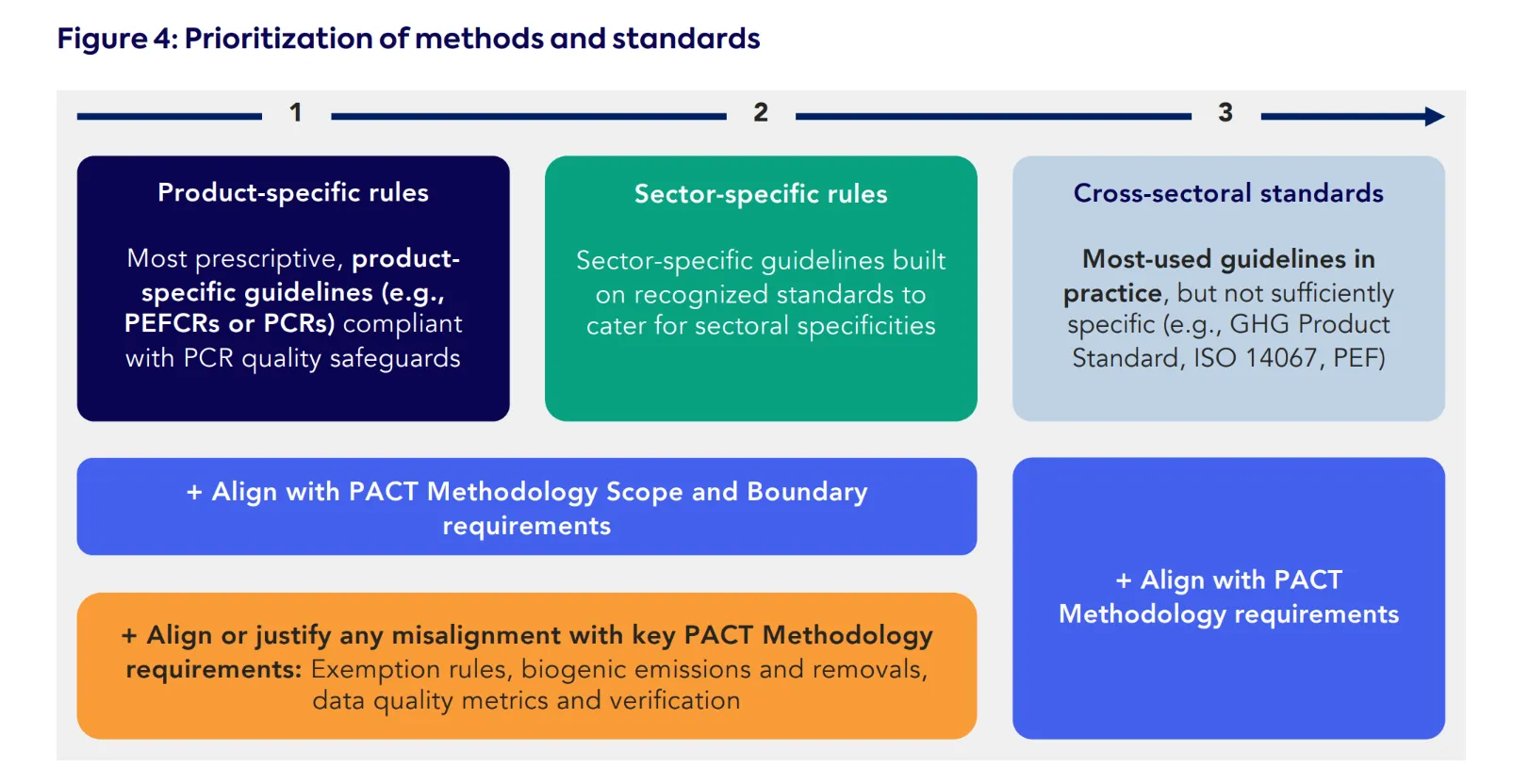
Source: PACT Methodology V3, accessible here.
The path forward: competing on a level playing field
The ultimate goal of carbon accounting is to enable companies to compete on a level playing field - where materials and products that serve the same function can be compared fairly based on their carbon performance. Only then can markets truly reward low-carbon innovation and drive meaningful decarbonization.
The product carbon accounting landscape continues to evolve, navigating the tensions and trade-offs outlined in this article. These discussions are far from settled, but that is a sign of progress, not failure. As methodologies mature, the challenge remains to balance precision with the practical realities of data collection across complex, global value chains.
The landscape’s current complexity reflects an ecosystem that is adapting to meet diverse business needs. As regulation tightens, customer expectations grow, and climate urgency intensifies, carbon accounting will continue to evolve.
Join the conversation
The PACT initiative has now expanded beyond the World Business Council for Sustainable Development (WBCSD) membership, opening participation to organizations of all sizes and sectors.
The carbon accounting field is evolving rapidly. By joining PACT, your organization can help shape the methodologies and interoperable systems that will define the next era of product carbon accounting.
Because you can’t reduce what you can’t measure - and you can’t measure effectively without speaking the same language.
Learn more about joining PACT and contributing to the future of carbon transparency at carbon-transparency.org/join-ecosystem.
