Good enough for which use cases? Mid-term results from the PCF Usability Model pilot
.webp)
Executive Summary
PACT members consistently tell us the main barrier to acting on product carbon footprint (PCF) data isn't a lack of data. It's uncertainty about whether the data they already hold is good enough to use, so supplier PCFs often get set aside.
The PCF Usability Model, published in April and built with the PACT community, addresses this. It combines Data Levels, which describe how much a PCF discloses, with a Fit-for-Purpose Matrix that links each business decision to the minimum Level it needs.
Since spring, practitioners from PACT member companies have tested the model against real supplier PCFs. Mid-term results across 118 data-to-use-case pairings show that 79% were usable for the decision tested: 60% fully and 19% with caveats. Only 21% were not fit for purpose. Further work will refine the matrix based on pilot findings and draw on input from assurance providers.
Read the article to discover more.
Disclaimer: The PCF Usability Model is a guideline. To share feedback or join the pilots, contact pact@wbcsd.org.

"Don't let perfect stand in the way of good" - or its close cousin, "choose pragmatism over perfection" - has become one of the most repeated phrases in the Scope 3 world. You'll hear it at every conference. You might even catch yourself saying it (and immediately regretting having said it).
Izzy Farnsworth shared: At PACT, we have been trying to figure out why the phrase can jar the scope 3 practitioner. We think we’ve landed on the answer: the phrase is empty. It tells you which direction to lean, but not where to stop.. or start. Without a structured, standardized, community-aligned definition of what practicing "pragmatism" truly means for PCF collection, everyone fills in their own version, and the well-intended phrase ends up achieving… nothing.
Within the PACT community we are lucky enough to work with an ecosystem of over 250, engaged corporate members and solution providers. We work with our members to overcome barriers to wide-scale adoption of PCF data collection and exchange across their supply chains.
Through our working groups and member conversations, enabled by the pre-competitive environment for peer-to-peer learning, sharing and collaboration, we heard that the single most common reason companies give for not acting on PCF data is not that they dont have data to act on. Instead, it's that they don't know what they can reasonably do with what they've already got: whether its complete enough, robust enough or accurate enough. In many cases, a PCF arrives from a supplier, and instead of asking "what can I do with this?," the instinct is to ask "is this good enough to use?," get an uncertain answer, and shelve it while waiting for something that might be better.
What has been done
With this being the case, PACT's PCF Usability Model was built by the PACT community, for the ecosystem to close that gap and provide guidance on how companies could use the data they already have - even when its incomplete.
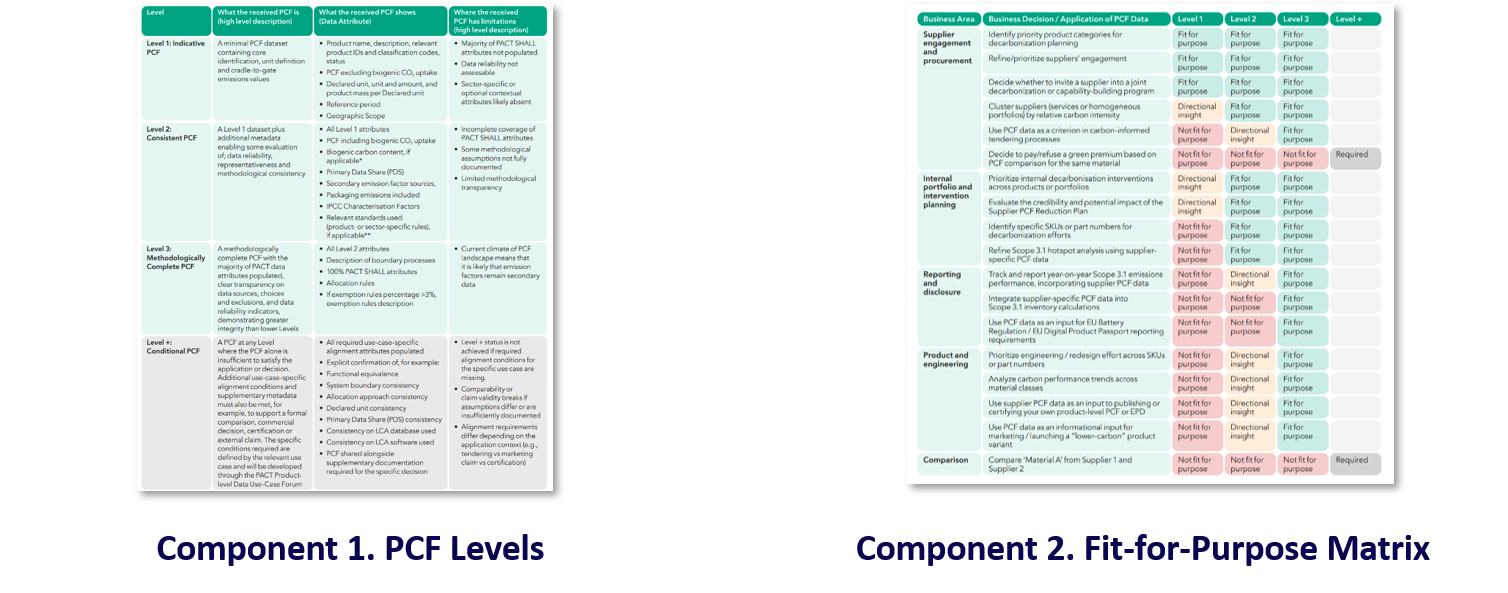
We published it back in April, and here is the high-level info of what we have done/found so far:
- We built the PCF Usability Model. It has two components. Data Levels. Fit-for-purpose matrix. They're used together.
- Data Levels describe what a given PCF discloses, from a minimal dataset at Level 1 to a methodologically complete one at Level 3. Then, Level + for any decision where more data than what is included in a PCF is needed for decision making purposes.
- The Fit-for-Purpose Matrix then maps each business decision, Scope 3 reporting, supplier engagement, carbon-informed tendering, to the minimum Level it realistically needs to be fit-for-purpose for that use case.
This spring and summer, practitioners from PACT member companies have been contributing their time, expertise and energy, testing the model against PCFs they've received from suppliers. This is not hypothetical or idealised data, but real supplier-specific primary data. Today, in the name of transparency, we want to share the mid-term verdict on the PCF Usability Model, and how it might be used to by businesses to help make decisions with the data available to them.
Our findings
The answer settles the question the industry keeps asking itself.
Across 118 real PCF data-to-usecase pairings, 79% were already usable, in full or in part, for the decision being tested.
60% were already fully fit for purpose for the use case being tested. A further 19% were partially fit (i.e. usable with caveats rather than unusable outright).
Only 21% turned out to be not fit for purpose. That suggests the default assumption, that “an imperfect PCF isn't ready to act on”, may be overly cautious: in four cases out of five, the data was usable, for at least some decisions.
And, that's the headline… But some more useful insights sit beneath it.
This isn't a story about all PCF data suddenly being OK to use. It's a story about companies being able to tell the difference. Agreement with the model's fit-for-purpose call rose cleanly with Level, 57% at Level 1, 62% at Level 2, 70% at Level 3, which means the framework isn't just confirming that data is usable, it's signalling which data is usable and for what.
Before the model, a company with 100 supplier PCFs and no team to go through and interrogate every single one had 2 options: trust all of it, option 1 or trust none of it, option 2. Now they can take the PACT guidance and feel more comfortable that, some data is at least ready for some use cases, and know roughly which fraction of their data needs more work, before it can be useable for the more “high stakes” decisions and applications.
That reframes the question companies could be asking. Not "is the data we have good enough?" which has no useful answer and stalls action. Instead: "which of my data is already good enough, and for which decision?" The validation pilot of the PCF Usability Model indicates that this second question often has a workable answer, and the model gives companies a proposed, structured way to work out which parts of their incoming data can be used, and for what decision making purpose or business application.
What’s next for the PCF Usability Model Use Case Forum?
For us at PACT, the pilot is evidence that the model is doing what it was designed to do: distinguishing usable data from unusable data with precision. The months ahead will advance “Phase 2” work with corporates, solution providers and assurance providers from the ecosystem: slightly recalibrating the matrix where our hypothesised pairings were proven false, drawing on input from the assurance provider community, including real-life pilot exchanges of PCFs with the Level concept applied.
For companies sitting on PCFs they've set aside, we think that this is the case for going back and testing them against the model. You may have already invested in supplier engagement: the training, the 1:1 calls, the Q&A sessions. That investment isn't lost just because the data didn't “seem” ready. Waiting for the "perfect" PCF means the next round of engagement will unlikely produce something magically different. The data you already hold is valuable now. You can use it to inform business decisions, show progress to leadership and move the needle on your operations.
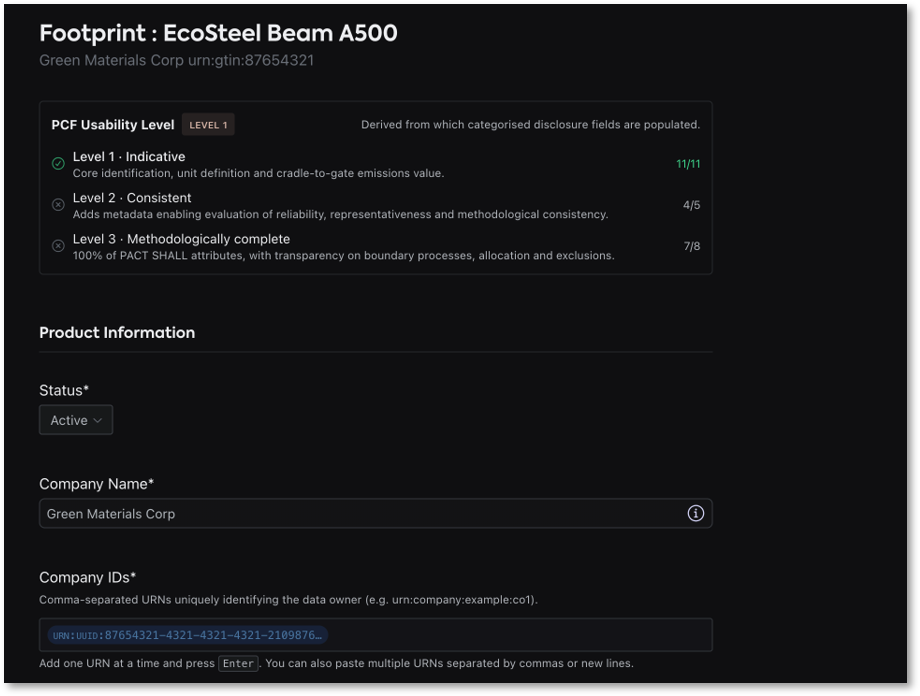
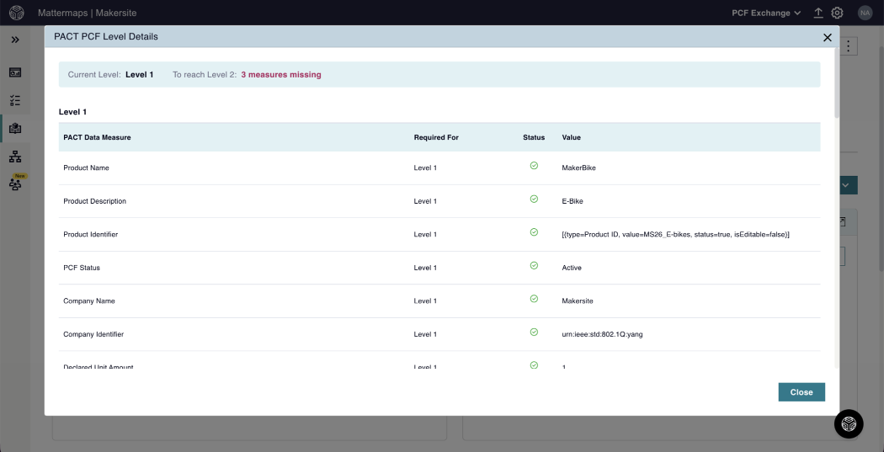
For solution providers, the structure of the model is what makes it scalable. Because it maps data attributes to decision types in a consistent way, it can be built directly into PCF exchange and carbon management tools. Incoming PCFs could then be assessed automatically on arrival, with each one flagged for the decisions it can support, instead of companies working through the matrix by hand. This is how the model moves from a framework to something teams use every day.
For assurance providers, the model offers a shared reference point for what "fit for purpose" looks like for a given decision. As PCFs are increasingly used for decision-making and external claims, a consistent way of linking data quality to its intended use can help align expectations between reporting companies, their suppliers and the assurance process. Your perspective is essential to getting this right, and Phase 2 will actively seek input from the assurance community on whether the Levels reflect what can be meaningfully assured.
We have done the work. Now it's your turn to put it into practice. Come get involved!
Disclaimer: the PCF Usability Model is a guideline. If you want to provide feedback on the model, or join the ongoing pilots, please contact us at: pact@wbcsd.org
