Enabling the next generation of product carbon footprinting for trusted results and practical implementation
.webp)

Today the role of PCFs has changed: they're operational business data, flowing across value chains into procurement, Scope 3 reporting, and regulatory filings. At the same time standards bodies are rewriting the rulebook in parallel: ISO, GHG Protocol, sector methodologies, digital frameworks all evolving at once.
In this article, we cover the most significant global changes coming to the field, from methodological interoperability (so PCFs built under different standards still mean the same thing), structured reporting (so downstream users trust what they're reading) to practical implementation (standards designed for real-world capacity, not just perfection).
PACT's role in this process is to be the translation layer. We are helping to build implementation guidance across industries and methodologies, test data exchange and more, so companies can navigate the expanding ecosystem without rebuilding for each framework.
Reading time: 4 minutes.

Product carbon footprints are outgrowing their origins. For years, they were bespoke technical studies, calculated once and read by a handful of specialists. They are now becoming operational business data, exchanged across value chains and built into everyday decisions.
To make that shift work in practice, standards and methodologies need to evolve not only for technical robustness, but also for usability in real business contexts.
PACT recently worked with product carbon footprint (PCF) experts from across its member community to review proposals for the evolving standards landscape for product carbon footprinting. This includes the co-development of a new product carbon standard through the ISO-GHG Protocol partnership (integrating ISO 14067 revision with the GHGP product standard). Together with its members, PACT considered the implications of these complementary developments for business.
While these discussions were prompted by a single PCF standard, they highlighted broader themes that extend well beyond any individual standard.
What we heard
1. Businesses want to use PCFs across a widening range of needs.
As PCFs become integral to procurement, supplier engagement, downstream product footprints, corporate Scope 3 reporting, and regulatory compliance, the demands placed on standards and methodologies are changing.
2. Business use means treating PCFs as operational resources.
Companies need PCFs they can trust, interpret consistently, readily exchange, and incorporate into business and reporting applications.
3. A new generation of standards presents a unique opportunity to design in essential principles.
The concurrent development of a new product carbon standard by ISO and GHG Protocol , the GHG Protocol Corporate and Scope 3 Standards, sector methodologies, and digital exchange frameworks creates an opportunity to strengthen accessibility, confidence, interoperability, and overall business value for PCFs, but only if these are prioritized and designed in early.
4. PACT complements this increasingly complex ecosystem.
As the ecosystem of standards becomes more complex, PACT continues to promote and enable harmonised implementation, methodological interoperability, and practical approaches for exchanging product carbon footprints across value chains.
Why this is a pivotal moment
The simultaneous evolution of international carbon-related standards is unfolding in parallel, covering product-level quantification alongside corporate greenhouse gas standards, sector methodologies, chain of custody, and market instruments. Together, this marks a pivotal chapter in the journey of product carbon footprinting.
For the first time, multiple complementary initiatives are evolving in parallel , each addressing a different aspect of an increasingly connected product carbon ecosystem. They provide a unique opportunity to better enable decarbonization of products and collaboration across supply chains.
Few organizations can now operate within a single methodological framework. Instead, businesses need to navigate an expanded portfolio of standards. Success will therefore depend not only on the quality of each individual framework, but also on how effectively they reinforce each other and how well they work together.
Through its work with companies across global value chains, the PACT community has observed three themes that the next generation of product carbon footprinting standards will need to address.
1. The new role for product carbon footprints
Historically, the primary challenge facing organizations for PCF work was how to calculate robust numbers for the study purpose. Today, the bigger question is how product footprints can be used confidently across connected value chains.
Product carbon footprints are no longer developed solely as internal studies with reports tailored to expert LCA practitioners. They are becoming operational business resources that support procurement efficiency, corporate reporting and compliance.
To fulfill that role, product carbon footprints must do more than provide scientifically robust emissions estimates. They need to provide comprehensive information, be interpreted consistently, be exchanged efficiently, and be readily incorporated into business processes. Increasingly, they must function as interoperable building blocks that support aggregation into downstream product footprints, corporate greenhouse gas reporting, and other business applications. This places new emphasis on two complementary forms of interoperability:
Methodological interoperability enables PCFs built with different but compatible approaches across interlinked standards, to be understood, share common meaning and be incorporated downstream with confidence.
Digital interoperability enables those PCFs to be exchanged with technical effectiveness and efficiency as structured, machine-readable data.
Figure 1 sets out how PACT sees the market and the role of PCFs shifting, from the common emphases of earlier PCF work toward emerging needs.
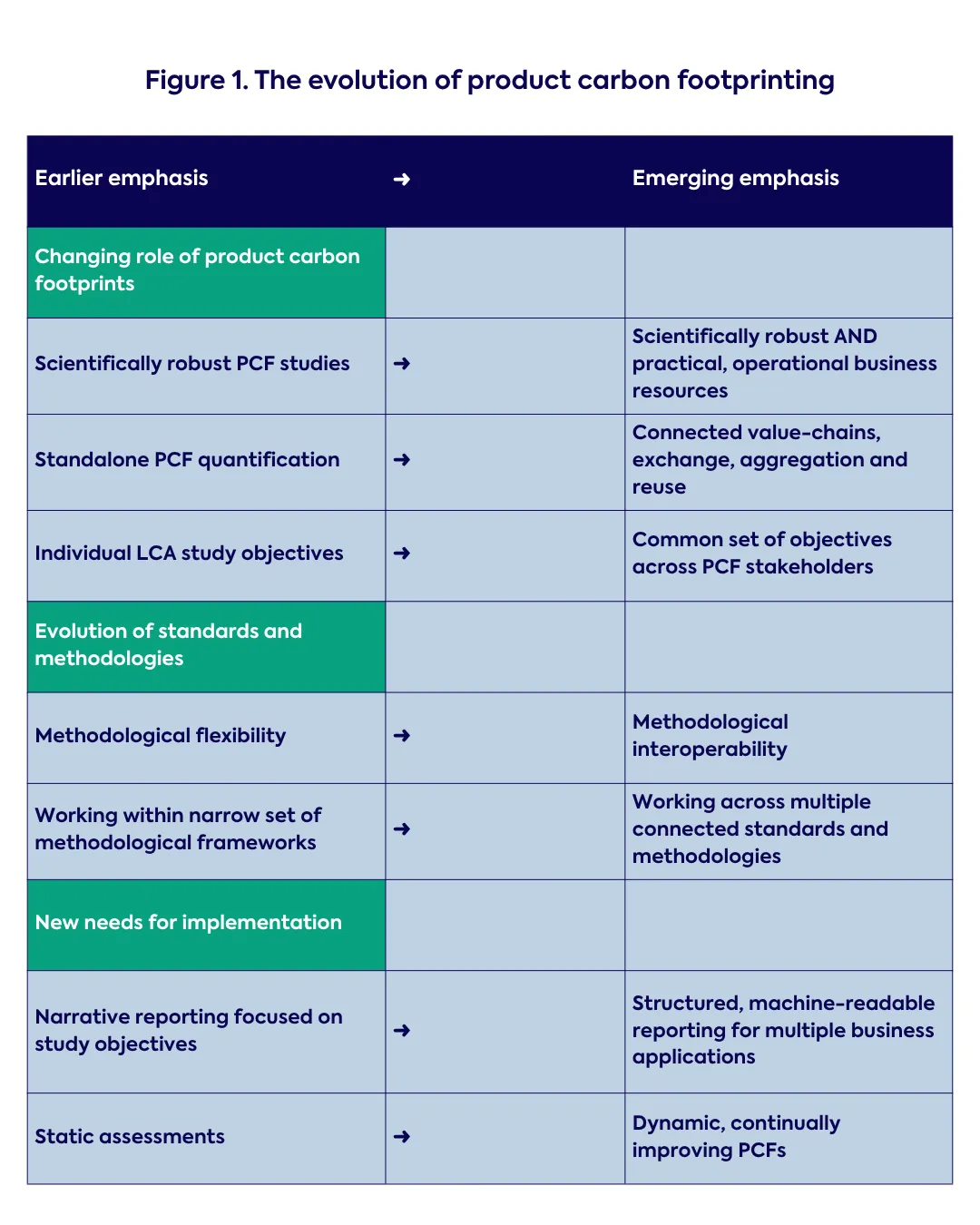
Figure 1. Scientific rigour remains a foundation of product carbon footprinting. However, as the role of PCFs evolves, increasing emphasis is being placed on enabling product carbon footprints to support connected business applications through greater interoperability, structured reporting and practical implementation.
2. Designing standards for real-world implementation
As PCFs become embedded within business processes, they are less likely to remain static studies produced at a single point in time. Businesses increasingly need practical approaches that allow footprints to be refreshed as supplier data improves, manufacturing changes, or decarbonization initiatives take effect. Standards should therefore be designed to better enable continual improvement, both in PCF integrity and in product decarbonization, and to help measure progress against these objectives.
Equally, the new set of standards must recognize the wide range of PCF maturity and capability across organizations, in developed and developing economies alike. Any new scope and options within the standard must be balanced against real-world capacity and cost barriers for potential adopters. Optionality and modularity offer a way to extend the reach and ambition of the standards while keeping them accessible to the multitude of businesses that need to take part in product carbon footprinting.
3. Building confidence in exchanged product carbon footprints
Confidence is established through three complementary elements: robust quantification, transparent reporting and proportionate assurance.
Structured reporting enables downstream users to see system boundaries, methodological choices, allocation approaches and data representativeness, while machine-readable reporting supports trusted exchange across organizsations. Assurance requirements for a new generation of standards should evolve alongside reporting, so that confidence grows while implementation stays proportionate and scalable.
PACT's role in an evolving ecosystem
No single framework can address every business need associated with product carbon footprinting, and realizing the full opportunity will take continued collaboration across standards bodies, sector initiatives, and implementation frameworks. PACT provides a cross-sector implementation layer: common implementation guidance, methodological harmonization, and technical specifications for digital exchange. This helps organizations apply complementary standards consistently, enabling trusted exchange while reducing unnecessary complexity across value chains.
The evolution of product carbon footprinting is still underway. As standards, methodologies, and digital exchange frameworks keep developing, practical implementation experience will matter as much as methodological innovation.
PACT welcomes continued engagement from organizations across the value chain on how we can collectively realize the opportunities presented by this important chapter. By sharing implementation experience, participating in methodological development and helping design harmonized approaches, businesses can shape the next generation of product carbon footprinting, ensuring it remains scientifically robust, practically implementable, and both methodologically and digitally interoperable.
Above all, our ambition is to make product carbon data more valuable to businesses: enabling better decisions, deeper collaboration, greater transparency and faster decarbonization across global value chains.
