Breaking Down the Barriers to PCF Data Exchange: Introducing the PACT Sandbox

Across the PACT community, we hear a version of the same story again and again: a company has calculated its Product Carbon Footprints (PCFs). Its suppliers are willing to share data. The standard exists. The technology exists. And yet, when it comes to actually moving that data from one system to another, the process stalls, falling back on spreadsheets, emails, and manual workarounds.
The bottleneck is not calculation. It is exchange. PACT team has designed Data Exchange Sandbox to fix that. Using a zero-cost, low-risk environment to connect platforms, it gives the opportunity to run pilots for data exchange.This article introduces the new opportunity and explains how companies and software providers can leverage it for their benefit.
What is the PACT Data Exchange Sandbox?
Think of the Sandbox as a controlled lab environment for data exchange: a secure, neutral space where organizations can experience, test, and demonstrate PACT-conformant PCF data exchange in practice. It isolates the step that most often breaks down in real-world pilots, the moment data has to move from one system to another, so it can be proven to work before anyone commits to a full integration. Formally, the core Data Exchange Platform (Sandbox) v1.0 covers node management, PCF upload and exchange, organization and user administration, and environment management.
It is also important to be clear about what the Sandbox is not. It is not a PCF calculation tool. It is not a replacement for solution providers. And it is not a PACT-owned platform competing with the software ecosystem. It is a neutral exchange layer that makes the PACT Network, the open standard and ecosystem of conformant software that lets carbon data move between companies - visible, testable, and real, particularly for organizations that have struggled to get systems talking to each other.
Why it was built
PACT's Data Exchange Protocol defines precisely how PCF data should move between systems. But a standard on paper does not automatically translate into working integrations in practice. Three persistent barriers led to the Sandbox being built.
The integration problem. Every buyer-supplier pair using different software systems has historically faced a one-off integration challenge: endpoints to configure, authentication to negotiate, connections to maintain. With many suppliers across a supply chain, this compounds fast. N suppliers × M buyers creates a large number of bilateral IT projects, each requiring coordination across companies and IT departments and each capable of delaying a pilot by months.
The tooling gap. Tier-2 and Tier-3 suppliers often hold the most relevant emissions data, yet they are frequently excluded from data exchange pilots because they have not yet selected or implemented a PACT-conformant solution. Historically, there was no on-ramp for these suppliers, so pilots either waited on vendor selection decisions or proceeded without the most important data.
The visibility gap. For buyers, sustainability leads, and non-technical stakeholders, the concept of a "PCF API" (an interface that allows software systems to request and share data automatically) is abstract. There has been no easy way to demonstrate what the PACT Network actually looks like in motion. This has contributed to a persistent misconception: that PACT Conformance is about calculation, when in fact it is about exchange.
The Sandbox addresses all three.
What you can do with it
Imagine a shampoo manufacturer that wants to share its product carbon footprint with a retailer. Its Tier-2 ingredient suppliers hold relevant emissions data too. In the Sandbox, each party is set up in the exchange: the retailer requests a PCF from the manufacturer, the manufacturer in turn requests ingredient-level PCFs from its Tier-2 suppliers, and the data flows up the chain in a single, standardised, PACT-conformant format. What would once have taken months of cross-company IT coordination can be demonstrated and validated within a single pilot.
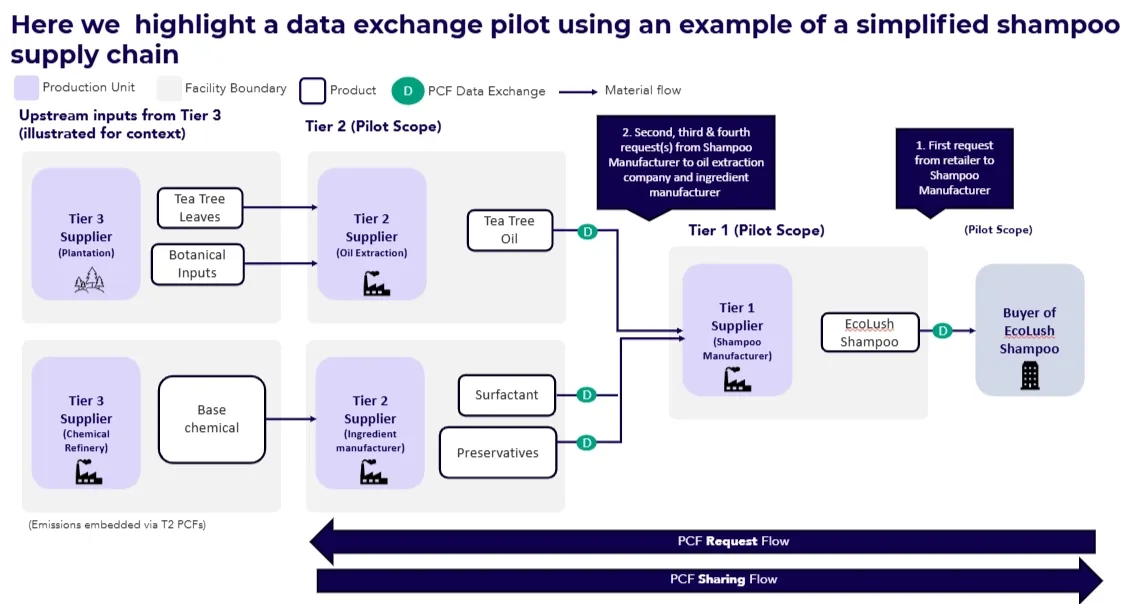
Here's how that works. Each participant - a company, a business unit, a software solution - is represented as a node: simply a connection point within the exchange. Once nodes are created and connected, PCF data flows between them following the PACT Data Exchange Protocol.
There are two types of nodes:
- External nodes represent existing PACT-conformant software solutions that connect to the Sandbox as they would to any other PACT endpoint.
- Internal nodes are hosted within the Sandbox itself, designed for suppliers who do not yet have their own conformant software, providing an immediate on-ramp without requiring a vendor selection first.
The exchange itself follows a clear sequence:
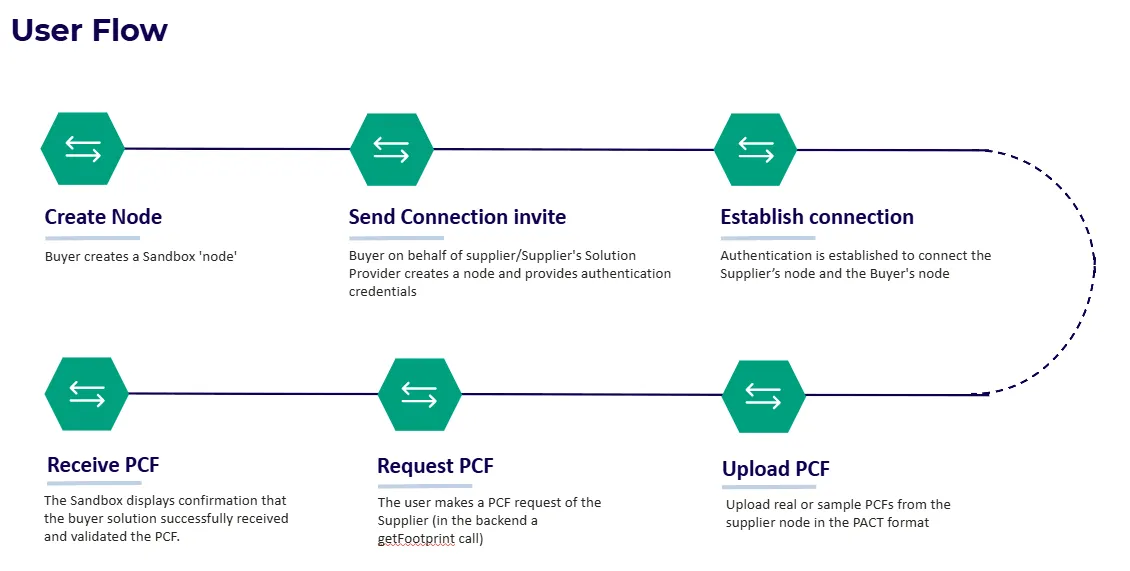
- Create a node: The buyer creates their Sandbox node, representing their organisation.
- Send a connection invitation: The supplier creates their own node (or their solution provider does), and provides authentication credentials.
- Establish the connection: Authentication is confirmed, linking the two nodes.
- Upload PCF data: The supplier node uploads real or sample PCF data in the PACT format.
- Request a PCF: The buyer node sends a request across the connection.
- Receive and validate: The Sandbox confirms that the buyer solution successfully received and validated the PCF.
The whole process can be completed with no bilateral IT project per supplier and no dependency on a vendor having been selected.
For privacy, PCFs are visible only to the node that owns them and any parties they have explicitly chosen to share with. In real-world deployments, data storage stays with solution providers. PACT does not hold or retain PCF data centrally.
Who is it for?
The Sandbox is relevant across the PACT community, but it is particularly valuable for:
- Buyers and sustainability leads who want to see PCF data exchange in action before committing to a full implementation, or who need to make the case internally that automated exchange is achievable.
- Suppliers without PACT-conformant software yet, who want to join a data exchange pilot immediately using an internal demo node, while their longer-term software decisions are still being made.
- Solution providers and technical teams who want to test and debug integrations (authentication, endpoint configuration, data validation) in a safe, managed environment, without the overhead of live bilateral integration.
- Anyone making the case for PACT who wants to show colleagues, customers, or partners what the PACT Network looks like in motion, in a concrete and visual way.
How to get started
The Sandbox is accessible via PACT Network Services.
1. Access the platform. Visit services.carbon-transparency.org to access the PACT Network Services portal, where the Sandbox is available alongside the PACT Conformance Tool.
2. Create your node. Sign up or log in, then create a node representing your organisation. If you are setting up on behalf of a supplier, you can create a node for them directly within the platform.
3. Connect and exchange. Send a connection invitation to your counterpart and run through a full request-and-receive exchange (the six steps above), now with your own setup.
4. Request a demo. If you would like a guided walkthrough before getting started, reach out to Arunav Chakravarty at chakravarty@wbcsd.org to arrange a demo session.
Part of a larger mission
The PACT Data Exchange Sandbox is one piece of a growing infrastructure. Alongside the PACT Conformance Tool, which validates that a solution correctly implements the PACT Technical Specifications, the Sandbox provides the next step: showing what conformance enables once it has been achieved.
PACT's goal has always been to make granular, primary-data-based product carbon footprints flow at scale across global supply chains. More than 4 million PCFs were calculated within the PACT Network in 2025. The challenge now is ensuring those PCFs move reliably, automatically, and at the speed that climate action requires.
The Sandbox exists to make that possible.
Have questions or feedback on the Sandbox? Write to us at pact-support@wbcsd.org


.avif)