How do companies turn product carbon footprints into business value? Lessons from the PCF Clinic.
.webp)

The market is moving.
The question is no longer should we ask for Product Carbon Footprints (PCFs)? It’s what will we actually do with this data?
Across industries, PCF requests are increasing. Methodologies are maturing, and data exchange is becoming more structured. Yet, as implementation advances, a more strategic challenge is surfacing. The constraint is no longer calculation. It is integration. How do we translate product-level carbon data into business decisions that shape sourcing, product design, supplier collaboration, investment and decarbonization decisions?
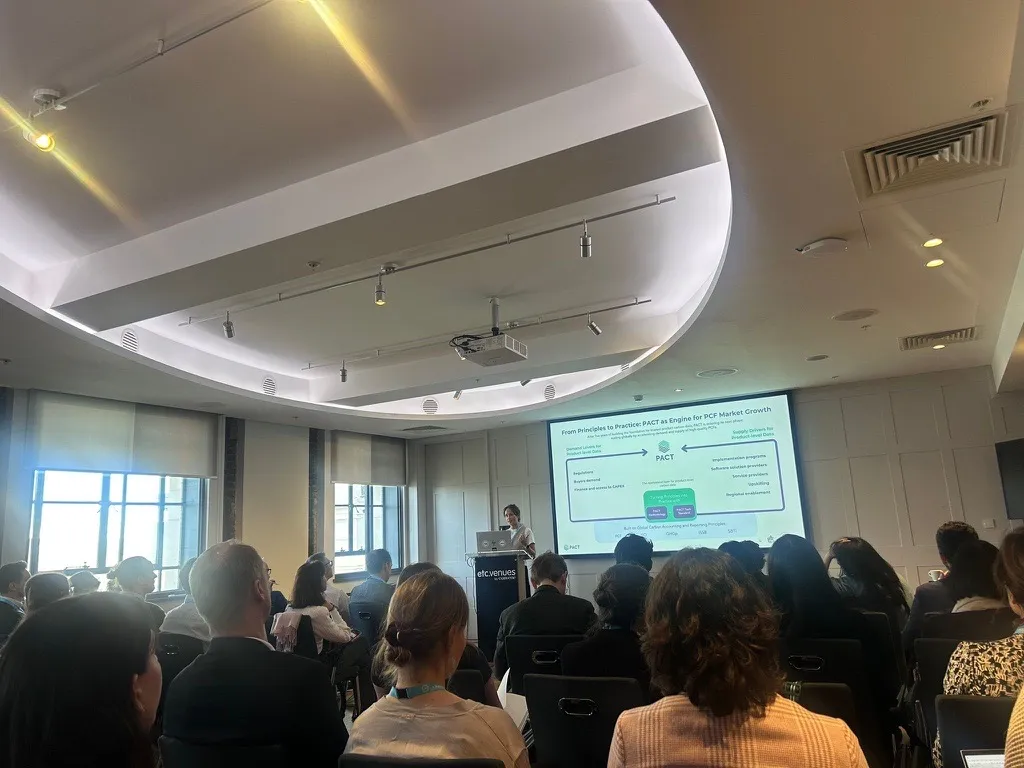
This was the underlying theme of the PCF Clinic in London on 4 February, where PACT and the Scope 3 Peer Group brought companies together to grapple with their most grizzly PCF implementation questions. The discussion focused not on theory, but on application: usability, comparability, scalability and trust.
Ahead of the session, participants submitted 200+ questions. What surfaced was not confusion about methodology, but friction in application.
1. Using PCFs as decision tools, not just reporting metrics
Many companies are receiving PCFs, but far fewer are integrating them into decisions.
Carbon data only truly creates value when it informs a choice. To name a few: selecting a supplier, prioritizing product design, allocating capital, setting incentives, structuring a supplier programme. Without a clear decision context, product carbon data risk remaining static reporting outputs.
A consistent insight emerged: business functions do not need methodological nuance, they need clarity on relevance. When does this number matter? What lever does it inform? What action does it trigger?
In some cases, full cradle-to-gate PCFs are necessary. In others, certain data can unlock faster action on its own, such as renewable energy adoption, input substitution and process efficiency, providing sufficient insight to act.
💡 Key insight: Define the use case first. Then, determine the level of carbon data required to inform it. PCFs create value when directly linked to procurement levers, supplier incentives and reduction programmes. Otherwise, they remain compliance outputs.
2. Making PCFs operational at scale without overwhelming the business
As PCFs expand beyond pilots, operational constraints become visible. Collecting PCFs across hundreds of suppliers without extensive consultancy support remains a significant hurdle for companies. Carbon accounting expertise does not sit across every function. Procurement teams, product designers, and business units cannot realistically become methodological specialists.
Automation and scalability depend on standardization. When shared methodologies and structure exchange formats are used, data flows more efficiently. However, when requests vary by customer or region, complexity multiplies and supplier fatigue increases.
The scaling challenge is therefore systemic. PCFs must integrate into existing business processes without introducing unsustainable frictions.
💡Key insight: Scalability requires simplification and interoperability. Clear guidance, structured templates and simplified exchange formats are prerequisites for embedding PCF collection into business-as-usual processes.
3. Making PCFs Comparable
Comparison is one of the most requested applications of PCF data, and one of the most difficult to solve for.
Suppliers use different methodologies, boundaries, reference years and data quality levels. Even where alignment appears strong, results can diverge significantly.
One company shared an example where two suppliers of a similar input product reported PCFs that differed by 60 percent. One used robust primary data; the other relied heavily on secondary datasets. The results should have been similar, yet they were not.
The conclusion was pragmatic: full comparability of supplier-provided PCFs remains a longer-term objective that we aim to unlock over time. In the near term, however, temporal comparison and structured transparency are both achievable with existing data and processes, and can already support meaningful decarbonization by enabling informed comparisons and better decision-making.
Depending on the business application, companies increasingly need PCFs accompanied by clear metadata, including methodological alignment, data sources and key assumptions. Without this context, comparison can mislead more than it informs.
💡Key insight: For comparison to be credible and scalable in the future, the foundational work begins with alignment on structure, transparency and common exchange standards.
4. When supplier-specific data adds value, and when it doesn’t
A recurring tension concerned the value of supplier-specific PCFs for decision-making or business applications, compared to generic or spend-based factors.
The answer was nuanced… In some categories, supplier-specific data reveals clear hotspots and unlocks targeted reduction pathways. In others, the marginal gain in accuracy does not justify the operational effort required.
One company shared a practical example: for renewable energy programmes, what matters is not a PCF, but simple activity data on the energy mix. Knowing the proportion of renewable versus non-renewable electricity is sufficient to size opportunity and measure progress.
The risk identified was “chasing perfect PCFs” without clarity on use. Companies need to define decision contexts first, then determine the minimum viable dataset required.
💡Key insight: Fit-for-purpose thinking should guide data requests. Supplier engagement should prioritise actionable levers, not methodological completeness for its own sake.
5. Validation, assurance and trust in data
Questions around assurance were pragmatic rather than theoretical.
What level of validation is realistic today? Full third-party audit at scale is not economically feasible. Yet without credible governance, trust erodes.
Peers discussed a number of approaches: tiered assurance approaches, combining transparency, structured data fields, selective verification, and embedded traceability. Metadata discipline may, in many cases, deliver more value than blanket audits.
The emergence of AI-assisted PCF creation adds further complexity. Automation can accelerate scale but only if it preserves traceability, data provenance and interpretability, whether calculations are manual, automated or hybrid. Assurance frameworks need to accommodate both traditional and AI-supported models.
💡Key insight: The direction of travel is clear: scalable governance will rely on standardized structures, comparable metadata and proportionate verification. There is still work to be done to unlock trust in the data!
What this signals for the next phase of PCFs
The London PCF Clinic made one reality clear: the question is no longer whether to act, but where to focus. The market is converging around practical principles:
Start with the decisions you want to inform, not datasets.
- Request fit-for-purpose data.
- Align on available methodologies and interoperable exchange structures.
- Build supplier collaboration into the model.
The next phase of PCF maturity will be defined less by methodological developments and more by businesses understanding where and how to create tangible value from PCFs.
PACT-aligned PCFs, exchanged through interoperable technologies, represent the ultimate destination of this journey: carbon data that can move seamlessly across systems, organizations and value chains, reducing friction while preserving credibility and comparability.
When companies share implementation experiences, contribute real use cases and test interoperable approaches together, they accelerate progress for the entire ecosystem, making product-level carbon data far more practical to use at scale.
If your organization is navigating these same challenges, we invite you to engage.
Learn more about joining PACT: Join PACT | Drive Supply Chain Decarbonization
To share a use case or connect with the team: pact@wbcsd.org
We look forward to continuing the conversation at the next PCF Clinic during London Climate Action Week in June 2026.